What Goes Into Designing a Custom EPS Mold (And Why It Matters)
When customers request a custom molded EPS part, one of the first surprises is often the tooling cost.
“Why does the mold cost so much?”
It’s a fair question.
The reality is, a custom EPS mold isn’t just a startup expense—it’s the foundation of your entire packaging program. The decisions made during design directly impact part cost, product protection, and long-term efficiency.
So what actually goes into designing a custom EPS mold, and why does it matter?
1. Understanding the Product Requirements
Every successful mold starts with a deep understanding of the product it’s protecting.
Key considerations include:
- Product dimensions and weight
- Fragility and drop test requirements (ex: ISTA 3A)
- Temperature control needs (for coolers or medical packaging)
- Shipping and handling conditions
This phase is critical because poor upfront design leads to costly issues later, product damage, over-engineered parts, or unnecessary material usage.
A well-designed mold ensures the product is protected without adding excess cost.
2. Designing for Manufacturability
Not every design can be molded efficiently—or at all—without adjustments.
EPS molding requires:
- Proper draft angles for part release
- Strategic venting for steam and air flow
- Uniform wall thickness for consistent density
- Avoidance of undercuts unless complex tooling is justified
This is where experience matters.
Small design mistakes can lead to:
- Inconsistent part quality
- Longer cycle times (higher piece price)
- Increased scrap and inefficiency
A mold isn’t just about making a part, it’s about making that part efficiently, every cycle.
3. Material Selection & Density Planning
EPS isn’t a one-size-fits-all material.
Designing the mold also means selecting:
- The correct bead type
- Target density (impacting strength and insulation)
- Additives (recycled content, biodegradable options, etc.)
Higher density increases strength, but also increases cost and cycle time.
The goal is to engineer the lowest density that still meets performance requirements, which directly reduces your cost per part over time.
4. Mold Construction & Tooling Complexity
This is where most of the upfront investment comes in.
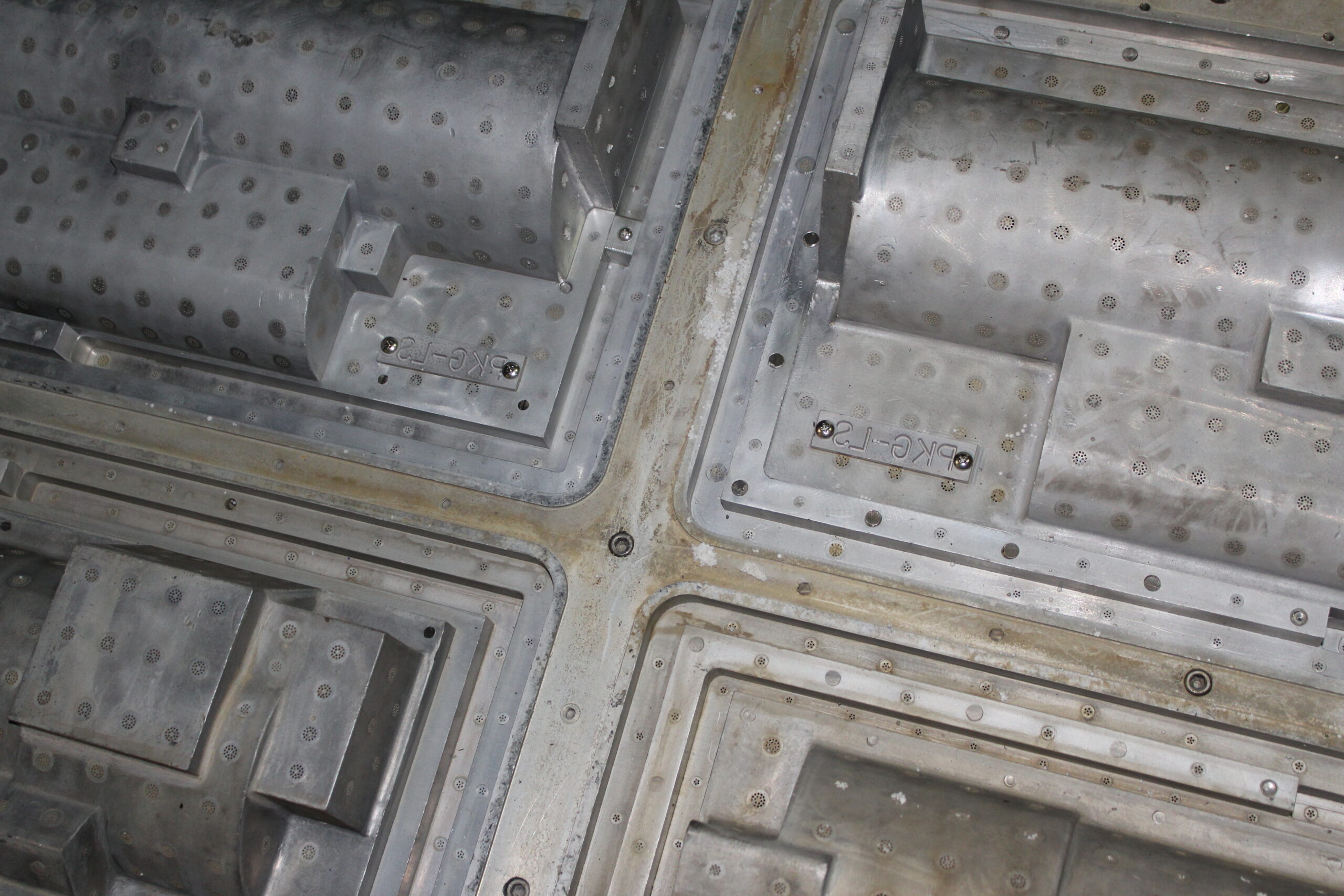
EPS molds are precision-built aluminum tools designed to handle:
- Steam pressure
- Cooling cycles
- High-volume production
Tooling cost depends on:
- Part size and geometry
- Number of cavities
- Complexity (slides, actions, inserts)
- Surface finish requirements
It’s important to understand:
This isn’t a temporary fixture—it’s a long-term production tool.
5. Prototyping & Testing
Once the mold is built, there’s always a dialing-in phase.
This includes:
- Adjusting steam, pressure, and cycle times
- Evaluating part consistency
- Performing drop testing and validation
Every mold has a learning curve, and this phase ensures the part performs as intended—both in production and in the field.
Skipping or rushing this step can lead to long-term performance issues.
6. Scaling to Production
A good mold doesn’t just produce parts, it produces them efficiently at scale.
At higher volumes, success means:
- Consistent cycle times
- Minimal scrap
- Reliable quality across thousands of parts
This is where a properly engineered mold pays for itself.
Looking at Mold Cost the Right Way
One of the biggest misconceptions is viewing tooling as a one-time expense rather than a long-term investment.
When spread across production volume, the cost per part becomes minimal.
For example:
- A $10,000 mold over 100,000 parts = $0.10 per unit
- Over 250,000 parts = $0.04 per unit
At that point, the real focus becomes:
- Part cost
- Efficiency
- Product protection
Not the initial tooling number.
Final Thought
Designing a custom EPS mold is equal parts engineering, material science, and manufacturing experience.
At Armstrong Brands, we approach every mold as a long-term production solution—not a short-term sale.
Because the goal isn’t just to build a mold.
It’s to build a program that works.
Ready to Get Started?
If you’re evaluating a custom EPS project, we’re happy to review your product and provide guidance upfront, before you commit to tooling.